
Connecting Ontario’s agriculture industry to safe consumption.

Connecting Ontario’s agriculture industry to safe consumption.
Case-study focus
User research, service design
Industry
Agriculture
Softwares
Miro, Figma
Methodologies and Artefacts
data triangulation
interviews
service design
service blueprinting
stakeholder consulation
survey
user research
workshopping
Case-study focus
User research, service design
Industry
Agriculture
Softwares
Miro, Figma
Methodologies and Artefacts
data triangulation
interviews
service design
service blueprinting
stakeholder consulation
survey
user research
workshopping
Case-study focus
User research, service design
Industry
Agriculture
Softwares
Miro, Figma
Methodologies and Artefacts
data triangulation
interviews
service design
service blueprinting
stakeholder consulation
survey
user research
workshopping
Project overview: untangling regulation in a complex industry
The Ministry of Agriculture, Food and Agribusiness (OMAFA) regulates how agricultural products are produced and processed through several inspection programs. These programs cover everything from dairy and beekeeping to fruits, vegetables, livestock medicine, and meat. Staff inspect both the goods and the facilities they come from, such as slaughterhouses, farms, and bee frames.
Each product type is managed under its own program, with specific regulations and inspection protocols. This project explored the complexity of those programs and the systems behind them.
In response to COVID-19, OMAFA needed to modernize its inspection practices to maintain safety while adapting to new constraints. Many processes were offline or based on undocumented knowledge. This discovery-focused project aimed to map regulatory workflows, identify gaps, and surface opportunities for digital transformation.
I was brought in to lead the project after initial research had begun. Several programs still needed discovery work. My role involved guiding the next phase of research and synthesis.
Project overview: untangling regulation in a complex industry
The Ministry of Agriculture, Food and Agribusiness (OMAFA) regulates how agricultural products are produced and processed through several inspection programs. These programs cover everything from dairy and beekeeping to fruits, vegetables, livestock medicine, and meat. Staff inspect both the goods and the facilities they come from, such as slaughterhouses, farms, and bee frames.
Each product type is managed under its own program, with specific regulations and inspection protocols. This project explored the complexity of those programs and the systems behind them.
In response to COVID-19, OMAFA needed to modernize its inspection practices to maintain safety while adapting to new constraints. Many processes were offline or based on undocumented knowledge. This discovery-focused project aimed to map regulatory workflows, identify gaps, and surface opportunities for digital transformation.
I was brought in to lead the project after initial research had begun. Several programs still needed discovery work. My role involved guiding the next phase of research and synthesis.
Key process: stitching together programs, people, and policies
Key process: stitching together programs, people, and policies
This project covered a wide scope of programs, people, and policies. We implemented a range of research techniques in order to find the strengths and pain-points, both within and between Ontario's agricultural regulatory programs.
This project covered a wide scope of programs, people, and policies. We implemented a range of research techniques in order to find the strengths and pain-points, both within and between Ontario's agricultural regulatory programs.
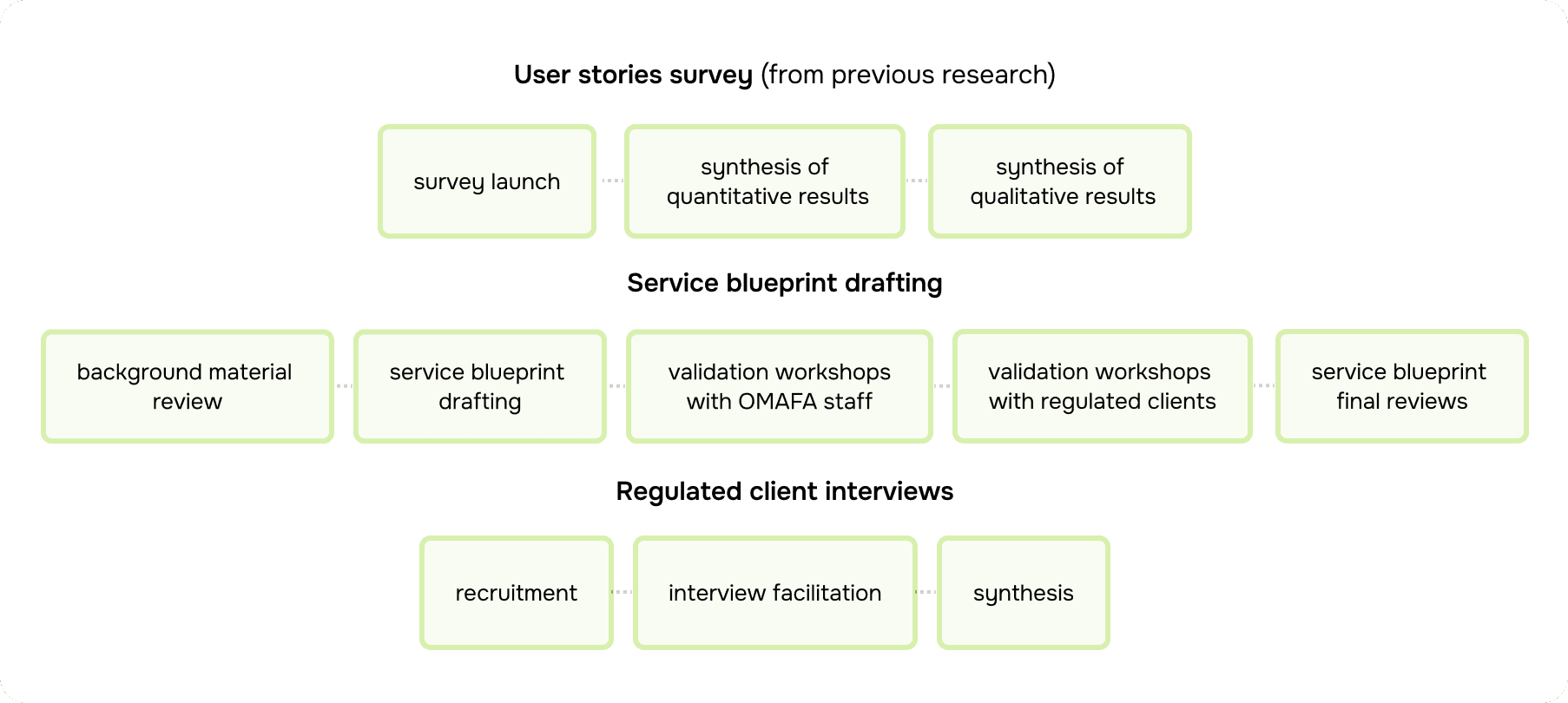
User stories survey (from previous research)
survey launch
survey launch
synthesis of quantitative results
synthesis of quantitative results
synthesis of qualitative results
synthesis of qualitative results
Service blueprint drafting
background material review
background material review
service blueprint drafting
service blueprint drafting
validation workshops with OMAFA staff
validation workshops with OMAFA staff
validation workshops with regulated clients
validation workshops with regulated clients
service blueprint final reviews
service blueprint final reviews
Regulated client interviews
recruitment
recruitment
interview facilitation
interview facilitation
synthesis
synthesis
Understanding the landscape
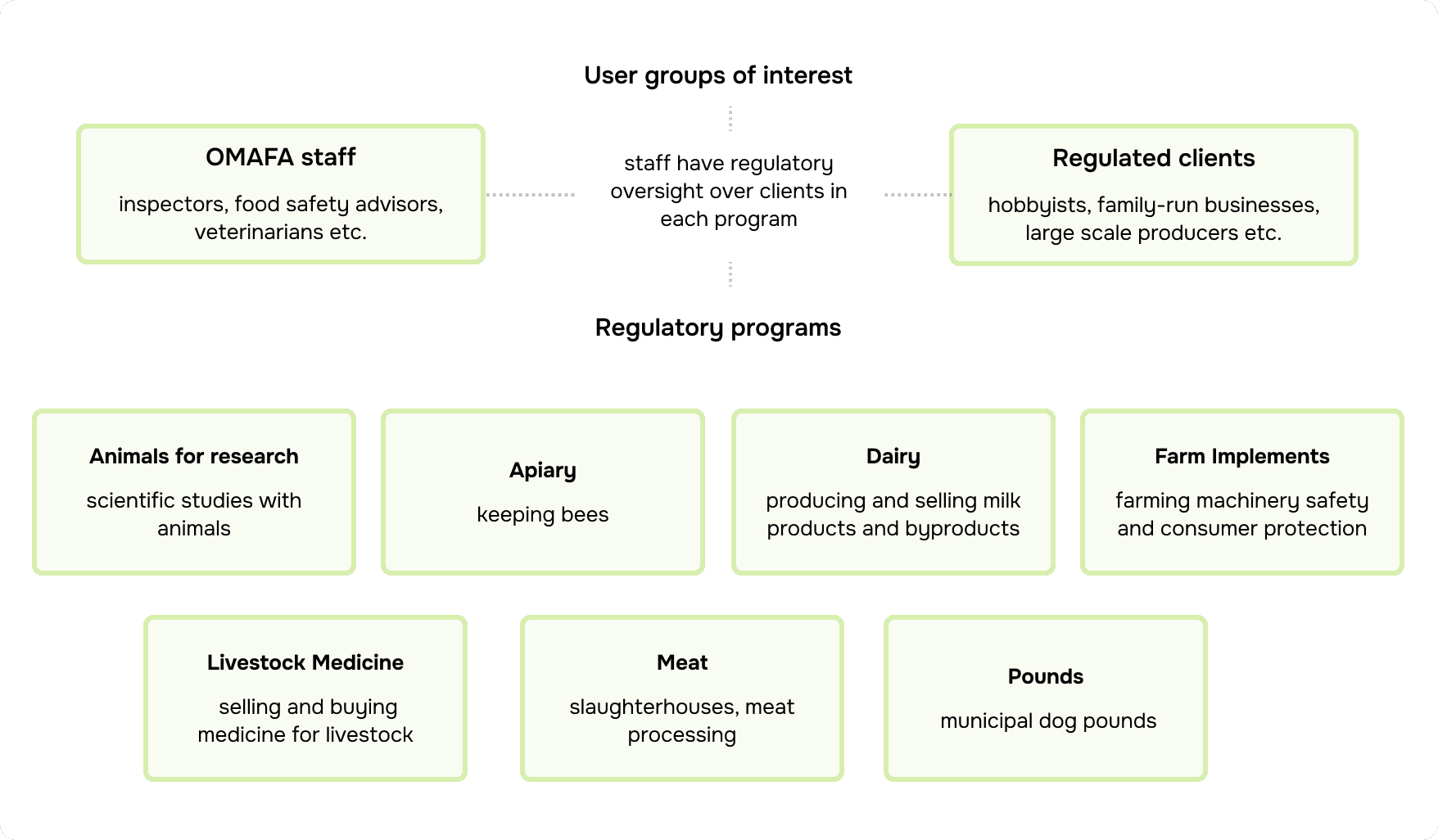
Our work focused mainly on seven key programs and began by learning about our users. On the back-end were OMAFA staff in a variety of roles, including inspectors, food safety advisors, veterinarians, and the provincial apiarist. On the front-end were the regulated clients, who ranged from hobbyists and family-run businesses to large-scale producers.
User groups of interest
OMAFA staff
inspectors, food safety advisors, veterinarians etc.
OMAFA staff
inspectors, food safety advisors, veterinarians etc.
staff have regulatory oversight over clients in each program
Regulated clients
hobbyists, family-run businesses, large scale producers etc.
Regulated clients
hobbyists, family-run businesses, large scale producers etc.
Regulatory programs
Animals for research
scientific studies with animals
Animals for research
scientific studies with animals
Apiary
keeping bees
Apiary
keeping bees
Dairy
producing and selling milk products and byproducts
Dairy
producing and selling milk products and byproducts
Farm Implements
farming machinery safety and consumer protection
Farm Implements
farming machinery safety and consumer protection
Livestock Medicine
selling and buying medicine for livestock
Livestock Medicine
selling and buying medicine for livestock
Meat
slaughterhouses, meat processing
Meat
slaughterhouses, meat processing
Pounds
municipal dog pounds
Pounds
municipal dog pounds
Research activities
We launched a survey informed by user stories from earlier research and shared it with both OMAFA staff and regulated clients. The data helped validate existing insights and surface new patterns.
Each user story was rated as very important, important, neutral, low importance or not important by survey participants. Some examples of the stories used for clients and staff are:
We launched a survey informed by user stories from earlier research and shared it with both OMAFA staff and regulated clients. The data helped validate existing insights and surface new patterns.
Each user story was rated as very important, important, neutral, low importance or not important by survey participants. Some examples of the stories used for clients and staff are:
As a regulated client, I need status updates and clear directions during the registration or licensing process so I know what to expect and can plan accordingly.
As a regulated client, I need to understand how and when to appeal a compliance decision so I can get fair, due process.
As a regulated client, I need status updates and clear directions during the registration or licensing process so I know what to expect and can plan accordingly.
As a regulated client, I need to understand how and when to appeal a compliance decision so I can get fair, due process.
As a regulated client, I need status updates and clear directions during the registration or licensing process so I know what to expect and can plan accordingly.
As a regulated client, I need to understand how and when to appeal a compliance decision so I can get fair, due process.
As an inspector, I need a standardized training program so that I can perform my job consistently and comparably to my colleagues.
As an inspector, I need autonomy over my schedule so that I can conduct inspections that meet program deadlines.
As an inspector, I need a standardized training program so that I can perform my job consistently and comparably to my colleagues.
As an inspector, I need autonomy over my schedule so that I can conduct inspections that meet program deadlines.
As an inspector, I need a standardized training program so that I can perform my job consistently and comparably to my colleagues.
As an inspector, I need autonomy over my schedule so that I can conduct inspections that meet program deadlines.
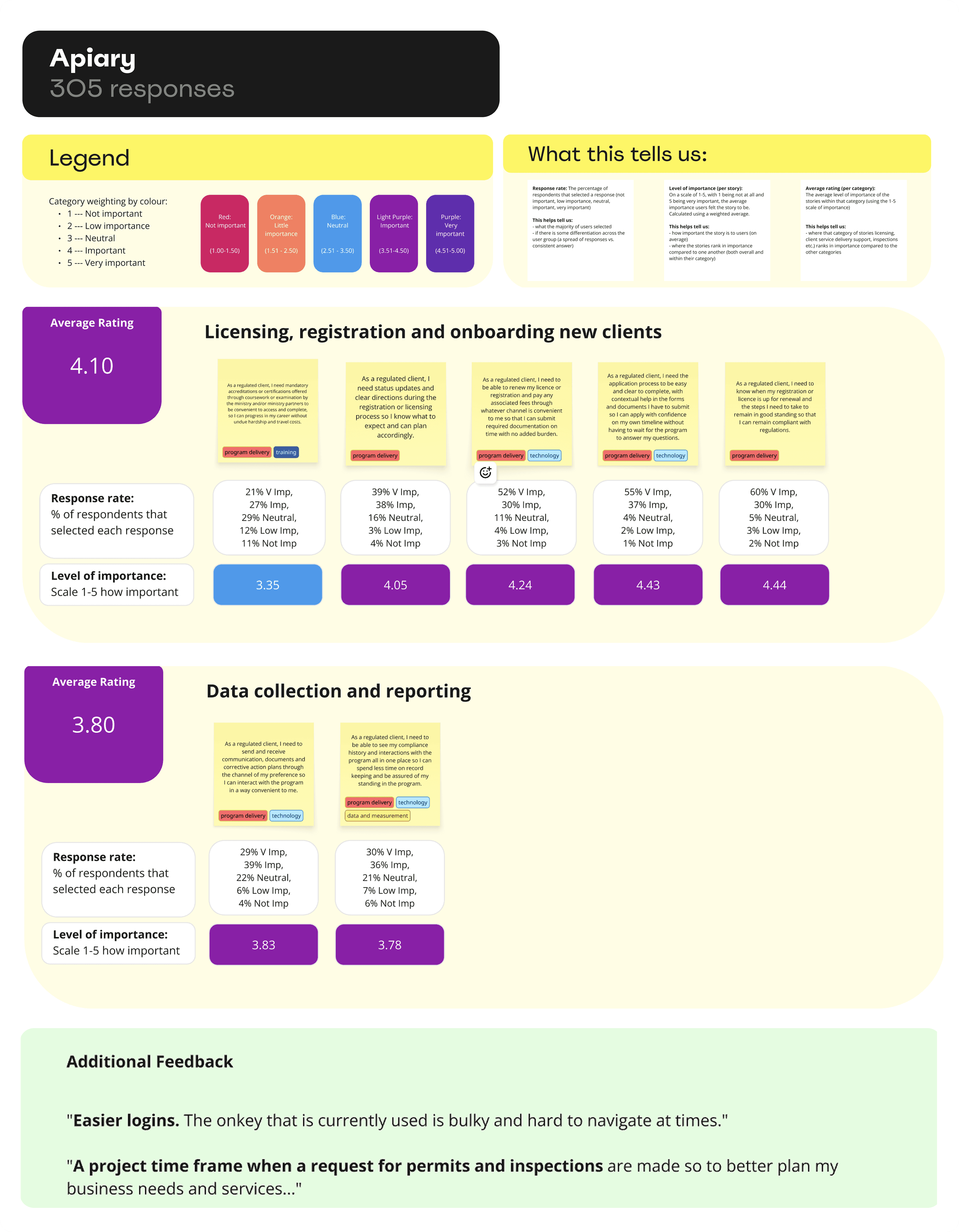
The quantitative survey data was summarized into a canvas on Miro. The qualitative survey responses were added to the canvas (below) in their original wording and later synthesized together with the qualitative insights from the interviews conducted during the project. Separate canvases were created for each program and role type.
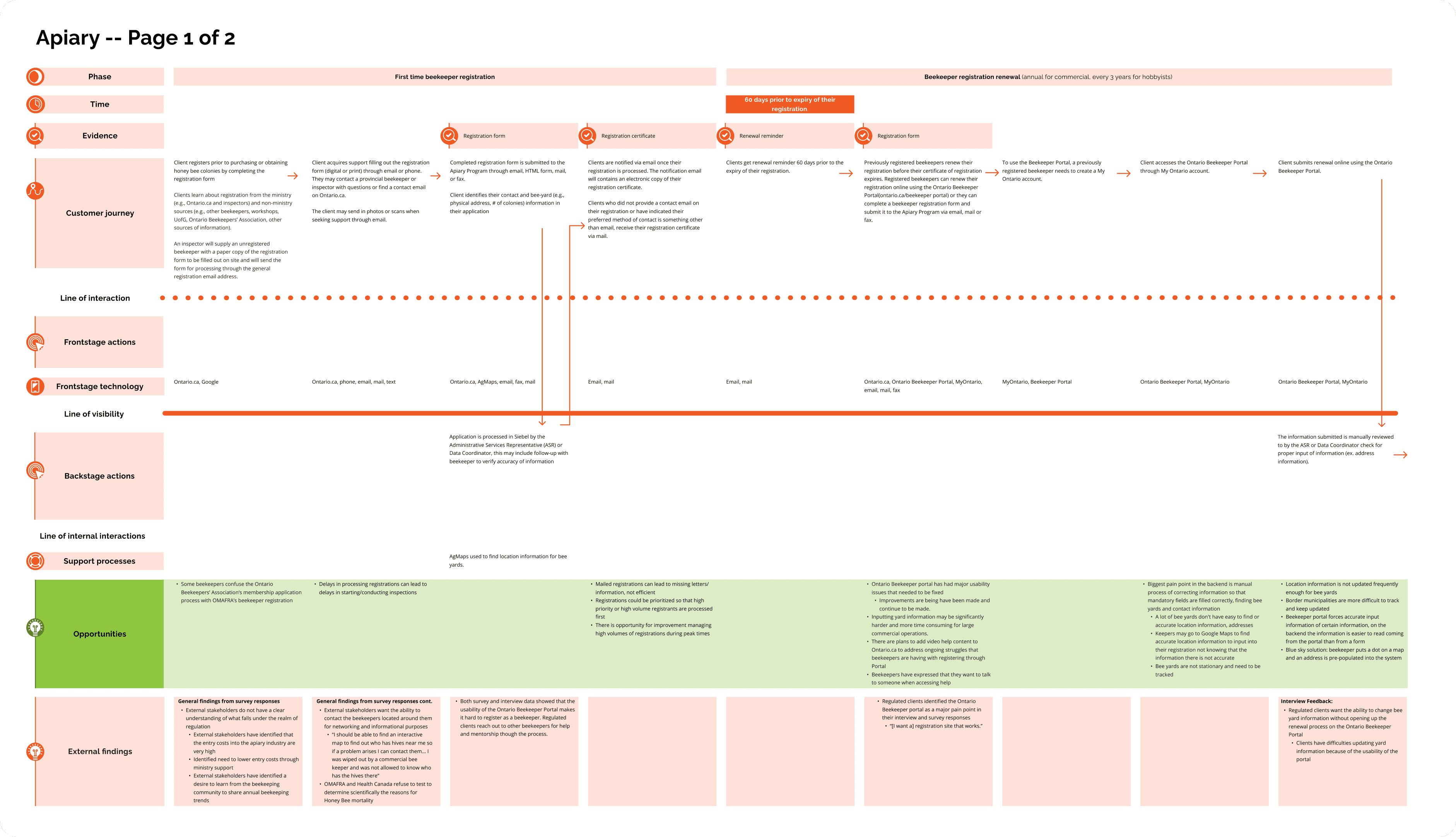
Next, we created service blueprints for each program. We reviewed public-facing content and internal documentation, developed first drafts, ran blueprint validation workshops with OMAFA staff, and conducted client interviews to map their experiences and touch-points.
Next, we created service blueprints for each program. We reviewed public-facing content and internal documentation, developed first drafts, ran blueprint validation workshops with OMAFA staff, and conducted client interviews to map their experiences and touch-points.
583
survey responses
583
survey responses
583
survey responses
7
service blueprints
7
service blueprints
7
service blueprints
13
blueprint validation sessions
13
blueprint validation sessions
13
blueprint validation sessions
Outcome and Impact: setting the foundation for modernization
This project provided OMAFA with clear documentation of how its regulatory programs functioned from both internal and external perspectives. The service blueprints we created became important tools for understanding service delivery across programs and identifying areas for modernization.
By combining staff insights, survey data, and client interviews, we were able to surface consistent pain points and communication gaps within and across programs. These findings helped OMAFA prioritize which workflows to digitize, where to improve transparency, and how to better support both inspectors and regulated clients.
Our work also strengthened relationships between ministry staff and the user research team, opening the door for ongoing collaboration and more user-centered approaches to policy and service design.
A portion of a service blueprint I made is included below.
Project reflections: what made this project complex and human
Working with a broad user base
Navigating program differences
Balancing perspectives
Sensitive topics
We quickly saw how diverse users in the agricultural industry really are. The sector includes everyone from large commercial producers with established systems to Mennonite farmers and first-time hobbyists with limited use of technology. Designing for this range meant accounting for different levels of digital literacy, communication styles, and production setups, often within the same program.
While the programs seemed similar at a high level, a closer look revealed that each one operated with its own nuances. Some required permits, licenses, and scheduled inspections, while others relied on one-off sampling or more informal interactions. Everything from sampling methods to data collection, equipment used, and how inspectors contacted clients varied from program to program.
Our research surfaced clear tension between inspectors and regulated clients. Inspectors often felt overwhelmed by workload, while clients sometimes found inspectors hard to reach. Both perspectives were valid. A key part of our role was listening closely and helping bridge the gap where possible.
Some conversations touched on more polarizing or sensitive topics. For example, the animals for research program raised issues around animal rights, which limited what could be shared publicly. We also heard frustrations about the broader political climate. This project took place while Donald Trump’s tariff decisions were making headlines in Canada, and some small businesses felt left behind by regulations that seemed designed for large-scale operations.
But wait - there's more! Want to learn more about this case study (or any of my other work)? Connect with me at kmahdiyya@gmail.com
Project reflections: what made this project complex and human
Working with a broad user base
Sensitive topics
We quickly saw how diverse users in the agricultural industry really are. The sector includes everyone from large commercial producers with established systems to Mennonite farmers and first-time hobbyists with limited use of technology. Designing for this range meant accounting for different levels of digital literacy, communication styles, and production setups, often within the same program.
While the programs seemed similar at a high level, a closer look revealed that each one operated with its own nuances. Some required permits, licenses, and scheduled inspections, while others relied on one-off sampling or more informal interactions. Everything from sampling methods to data collection, equipment used, and how inspectors contacted clients varied from program to program.
Our research surfaced clear tension between inspectors and regulated clients. Inspectors often felt overwhelmed by workload, while clients sometimes found inspectors hard to reach. Both perspectives were valid. A key part of our role was listening closely and helping bridge the gap where possible.
Some conversations touched on more polarizing or sensitive topics. For example, the animals for research program raised issues around animal rights, which limited what could be shared publicly. We also heard frustrations about the broader political climate. This project took place while Donald Trump’s tariff decisions were making headlines in Canada, and some small businesses felt left behind by regulations that seemed designed for large-scale operations.
But wait - there's more! Want to learn more about this case study (or any of my other work)? Connect with me at kmahdiyya@gmail.com
I acknowledge that this work was done on lands located on the traditional territories of the Wendake-Nionwentsïo, Anishinabewaki and Ho-de-no-sau-nee-ga (Haudenosaunee) peoples among other colonially occupied territories. As a settler, I hold privilege in being able to design experiences that impact indigenous folks. My aim is to curate experiences that are more inclusive and reconciliatory in regards to colonial impact by doing things like making sure indigenous voices are represented in the research and synthesis of the work I do.
0.32g of CO2 is produced every time someone visits this web page.
Wondering if I used AI (artificial intelligence)? AI was used sparingly to generate icons and copy edit (not draft) content for this webpage.
I acknowledge that this work was done on lands located on the traditional territories of the Wendake-Nionwentsïo, Anishinabewaki and Ho-de-no-sau-nee-ga (Haudenosaunee) peoples among other colonially occupied territories. As a settler, I hold privilege in being able to design experiences that impact indigenous folks. My aim is to curate experiences that are more inclusive and reconciliatory in regards to colonial impact by doing things like making sure indigenous voices are represented in the research and synthesis of the work I do.
0.32g of CO2 is produced every time someone visits this web page.
Wondering if I used AI (artificial intelligence)? AI was used sparingly to generate icons and copy edit (not draft) content for this webpage.
I acknowledge that this work was done on lands located on the traditional territories of the Wendake-Nionwentsïo, Anishinabewaki and Ho-de-no-sau-nee-ga (Haudenosaunee) peoples among other colonially occupied territories. As a settler, I hold privilege in being able to design experiences that impact indigenous folks. My aim is to curate experiences that are more inclusive and reconciliatory in regards to colonial impact by doing things like making sure indigenous voices are represented in the research and synthesis of the work I do.
0.32g of CO2 is produced every time someone visits this web page.
Wondering if I used AI (artificial intelligence)? AI was used sparingly to generate icons and copy edit (not draft) content for this webpage.